
Procrastination Is the Answer
It's not a discipline problem. It's two completely different problems wearing the same name.

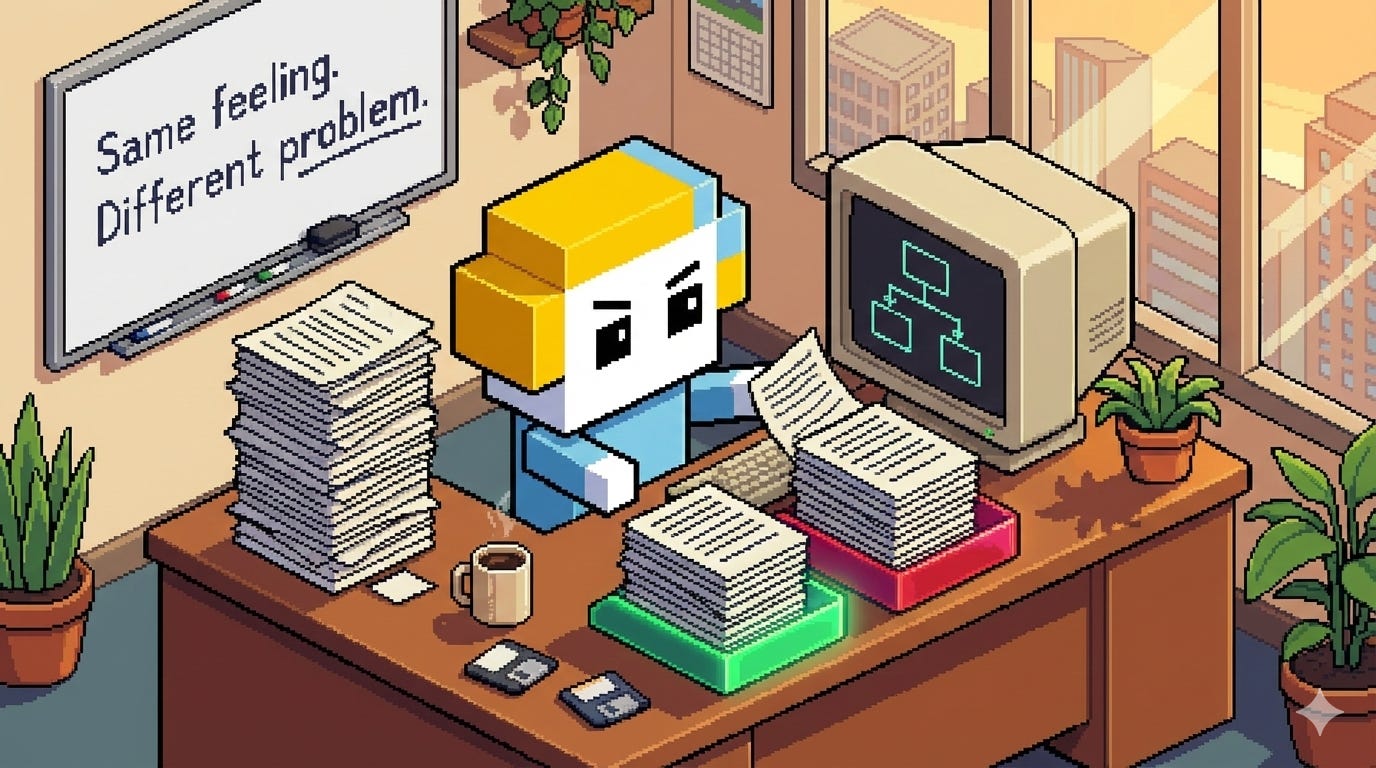
The word procrastination is doing too much work. It covers two completely different situations under one accusatory label, and then we wonder why the standard advice only lands half the time.
“Just start” works beautifully for one kind. For the other, it’s the worst thing you can do.
There are two kinds, and they point in opposite directions.
The first: you don’t actually want this thing. The project, the commitment, the goal you publicly declared. Somewhere between saying yes and sitting down to do it, something honest in you said no. The procrastination isn’t resistance. It’s your answer.
The second: you want it so much that the possibility of failure is unbearable. So you don’t start, because not starting means not failing. The wanting is the problem. You’ve confused “I can’t have this” with “I don’t want this” because the first one hurts less.
Both feel identical from the inside. That’s why generic productivity advice is a coin flip. You’re treating two different conditions with the same prescription.
Procrastination is your first honest answer.
Before the justifications. Before the productivity system. Before you tell yourself you work better under pressure (you don’t, and we both know it). The delay is not a failure of discipline. It’s a consultation. Something in you is working through a decision that your conscious mind hasn’t caught up to yet.
The interesting question is never “how do I stop procrastinating.” It’s “what is the procrastination telling me.”
Most people skip this entirely. They jump to tactics. Timer apps. Accountability partners. Breaking it into smaller pieces. And sometimes that works, because sometimes the problem really is just activation energy. But when it doesn’t work, they conclude they’re lazy or broken, when actually they were solving the wrong problem.
Here’s how you tell which kind is yours.
Ask yourself one question: if I knew this would work, if success were guaranteed, would I want to do it?
If yes, you have a belief problem, not a motivation problem. The procrastination is protecting you from potential failure. You don’t need discipline. You need a smaller first step, one small enough that failure doesn’t feel catastrophic.
If no, you have a permission problem. The procrastination is your honest answer, and the real work is letting yourself hear it. You don’t need a better system. You might need to stop.
Which one is yours right now?
Not in general. Right now. The thing you’ve been putting off this week. Run it through the question. The answer is usually faster than you expect, and more honest than you’re ready for.
If this made you pause, you might like what comes next. I write short observations about decisions, patterns, and the gap between intention and action. No content calendar. No filler.
Know someone who treats procrastination as a character flaw? Send them this.
